

Purchasing an off-plan property in Spain remains one of the most common ways to access high-quality new-build homes on the Costa Blanca and other coastal regions. For many international buyers, the process is unfamiliar: staged payments, construction timelines, legal guarantees and developer obligations differ from those in the UK, Northern Europe or the US.
This guide sets out the essentials: what “off-plan” actually means, how payments are protected, what the law requires from developers, and the points every buyer should verify before signing.
What Off-Plan Means in Spain
An off-plan property is a home purchased before construction is completed often before building has started. Instead of buying a finished unit, you buy a legally approved project backed by:
- a building licence (licencia de obra),
- technical documentation defining the development, and
- a guaranteed payment structure regulated under Spanish law.

Off-plan does not mean paying the full price upfront. It also does not mean handing money directly to the developer without safeguards. Spanish regulations are strict, and payments must be protected.
Special Account and Bank Guarantee: Two Different Protections
A special account and a bank guarantee are not the same thing. They form two separate layers of protection for advance payments made during construction.
The special account: ‘cuenta especial’
The developer must receive advance payments through a dedicated account held separately from its other funds. Money paid into this account may only be used for costs connected with the construction of the development.
Before making a payment, the buyer or their lawyer should verify that the account details correspond to the development’s designated special account. It is better to describe this as a special account rather than an escrow account, as the Spanish system does not operate in exactly the same way as a traditional third-party escrow arrangement.
The bank guarantee or insurance policy
The second protection is a bank guarantee (aval bancario) or surety insurance policy (seguro de caución). Its purpose is different: it protects the buyer’s advance payments if construction does not begin or the property is not completed by the contractual deadline.
The guarantee should cover:
- all advance payments made by the buyer;
- the applicable taxes paid with those amounts;
- statutory interest from the date each payment was made.
The buyer should receive a document identifying the property, the buyer, the guaranteed amount and the bank or insurer providing the protection. A reference to a general guarantee for the development is not, by itself, a substitute for confirmation that the buyer’s own payments are covered.
In simple terms, the special account controls where the money is held and how it may be used. The bank guarantee or insurance policy provides a route to recover that money if the developer fails to deliver the property under the agreed conditions.
What the buyer’s lawyer should verify
Before substantial payments are transferred, the lawyer should confirm:
- that the payment account is the designated special account for the development;
- which bank or insurer guarantees the advance payments;
- that the guarantee covers the buyer, the selected property, taxes and all agreed instalments;
- how the guarantee can be enforced if the development is not completed.
The Legal Framework: LOE 38/1999
The regulation of new-build and off-plan homes falls under the Ley de Ordenación de la Edificación (LOE 38/1999).
This law establishes:
- the obligations of developers, architects and contractors,
- the requirement to protect buyers’ deposits, and
- the liability periods for construction defects.
The LOE is the backbone of consumer protection in Spain’s new-build sector and is one of the reasons off-plan purchases are widely considered safe — provided due diligence is carried out.
The 10-Year Guarantee (Decennial Structural Insurance)
Every new-build property in Spain includes a set of compulsory guarantees:
The 10-year insurance (seguro decenal) is especially important. Without it, the developer cannot obtain the final habitation certificate (licencia de primera ocupación), meaning the property cannot be legally delivered to buyers.
Typical Off-Plan Payment Schedule
While individual developments vary, most off-plan purchases in Spain follow a similar structure:
1. Reservation
A small reservation fee (€3,000–€10,000) removes the unit from the market for a defined period while contracts are prepared.
Is It Safe to Pay a Reservation Deposit Directly to a Spanish Developer?
Paying a reservation deposit directly to the developer is common in Spain and is not automatically a warning sign. However, the buyer should verify the recipient, payment account and reservation terms before transferring any money.
The reservation document should clearly identify:
The payment should be made to an account belonging to the developer or another party expressly authorised in the reservation document. Buyers should not transfer money to a salesperson’s personal account or to account details that cannot be matched to the named recipient.
It is also important to establish whether the building licence has already been granted. Under the current protection regime, the developer’s obligation to guarantee advance payments applies from the granting of the building licence. If the reservation is being paid before that stage, the contract’s refund provisions become particularly important.
For this reason, the safest approach is to let an independent lawyer review the reservation document and confirm the payment instructions before the transfer. If the buyer must act quickly to hold a unit, the reservation should at least be made expressly subject to satisfactory legal checks and a clear right to recover the deposit if those checks are not passed.
2. Private Purchase Contract (Contrato Privado de Compraventa)
Usually signed within 2–4 weeks.
At this stage, buyers typically pay 10% of the purchase price, minus the reservation fee already paid.
What Should the Private Purchase Contract Include?
The private purchase contract is the main agreement governing the purchase before completion at the notary. It should be reviewed by an independent lawyer and should clearly define:
3. Construction Stage Payments
Staged payments: often 20–30% in total are made during construction.
Each payment must be:
- deposited in the project’s escrow account, and
- protected by an individual bank guarantee.
Developers usually tie instalments to construction milestones (e.g., completion of structure, façade, or installations).
4. Final Payment at Completion
The remaining 60–70% is paid at the notary upon delivery of:
- the finished property,
- the habitation certificate, and
- the final bank guarantee release.
This final payment is often financed through a Spanish mortgage, which is common for international buyers purchasing new-build property in Spain.

Example: Payment Schedule for a €300,000 Off-Plan Property
To see how staged payments work in practice, consider a new-build property with a purchase price of €300,000, excluding taxes.
A possible payment schedule could look like this:
| Stage | Payment | Amount |
|---|---|---|
| Reservation | Fixed reservation deposit | €6,000 |
| Private purchase contract | Balance required to reach 10% | €24,000 |
| During construction | Further 20% in agreed instalments | €60,000 |
| Completion at the notary | Remaining 70% | €210,000 |
| Total purchase price | 100% | €300,000 |
For a standard new-build home, 10% VAT would add another €30,000 to the overall cost. VAT is normally charged as the corresponding payments are made, rather than being left entirely until completion.
This means the buyer may need to contribute approximately €99,000 before completion:
- €90,000 towards the purchase price;
- €9,000 in VAT on those advance payments.
The remaining €210,000 purchase balance, plus €21,000 in VAT, would become due at completion. If the buyer uses a mortgage, the loan would normally contribute towards the outstanding property price after the bank has valued the completed home. Taxes and other purchase costs are usually paid from the buyer’s own funds.
This is only an illustration. Some developers request 20% before completion, while others require 30% or more. The reservation amount, instalment dates and tax treatment should therefore be checked against the payment schedule included in the private purchase contract.
What Buyers Should Verify Before Signing
A well-structured off-plan purchase is transparent and predictable. Before paying any deposit, your lawyer should confirm:
Project Legality
- Building licence (licencia de obra mayor) granted and in force.
- Developer registered and fully authorised.
- Technical project approved by the local municipality.
Financial Guarantees
- Bank guarantee or insurance for each payment.
- Escrow account details.
- Delivery deadline and penalty clauses.
Documentation Provided
- Full building specifications and materials list (memoria de calidades).
- Floor plans, orientation, parking/storage allocation.
- Community facilities and future maintenance obligations.
Developer Track Record
- Previous completed developments.
- Financial stability.
- Timelines met in earlier projects.
Good developers on the Costa Blanca are used to working with international buyers and maintain high transparency. Still, independent verification is essential.
FAQ: Buying Off-Plan Property in Spain
Quick answers for overseas buyers
About the author

SPACES & PLACES Exclusive Property S.L.
Information in this article is intended for general guidance only. Development details, pricing and availability may change; please verify all information directly with the developer or your trusted adviser before making any purchase decisions.

New Development in Villajoyosa, Spain
New-build apartments in Playa del Torres, Villajoyosa. Gated complex with pools, gym, sea views from selected homes and energy-efficient design. Construction underway.
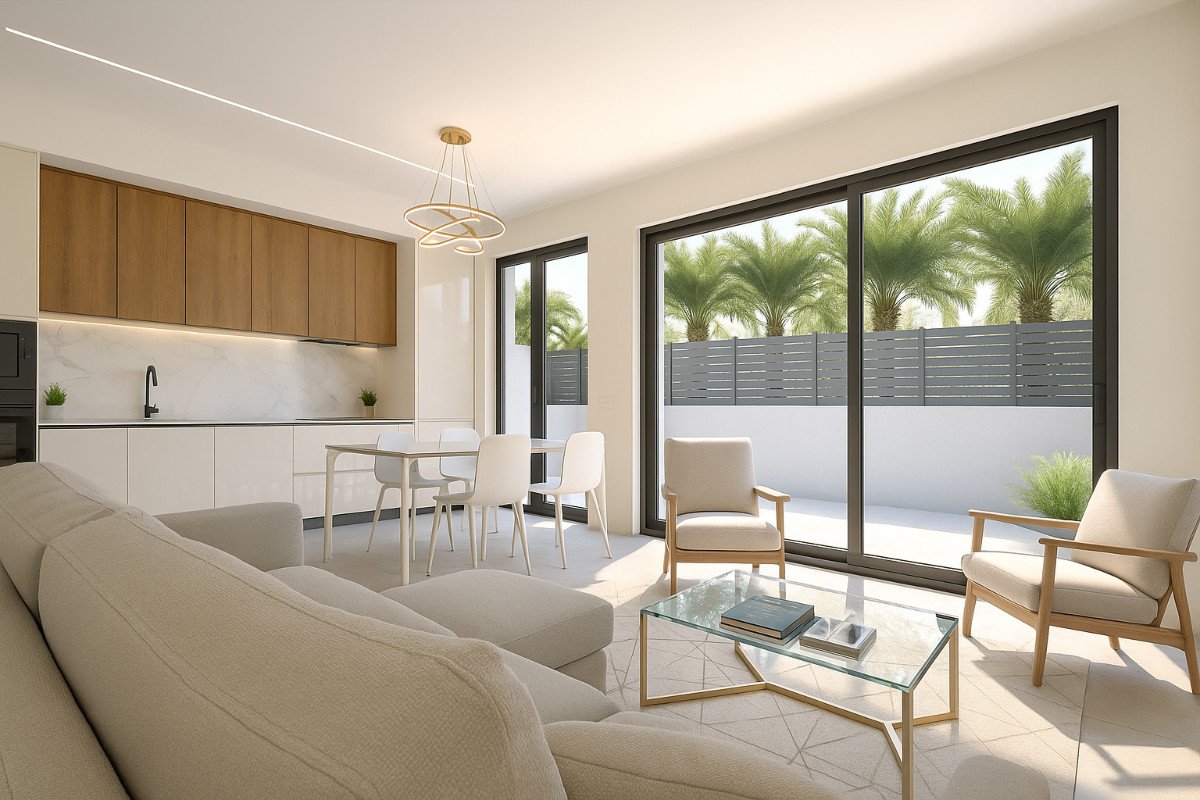
Key-Ready Townhouse in Valencia Suburbs
Modern turnkey home with private garden, terrace and high-quality finishes; featuring bright interiors, energy-efficient design and ready for immediate move-in.

New Development Apartments Costa Blanca
New-build apartments 200 m from the beach in El Verger. Property offers 1–3 bedroom homes, green communal areas and energy-efficient design.